
Why Is Medicai the Best for High-Performance Diagnostic Speed?
A radiologist at a multi-site clinic often waits 45 seconds for each large study to load on legacy systems. That delay stacks up across dozens of cases per shift and slows every downstream decision.
By the end of this article you will know exactly how Medicai's zero-footprint viewer, AI-supported workflow, and multi-location cloud PACS cut those wait times, how its pricing compares with other platforms, and whether the solution fits your practice size.
What Is Medicai?
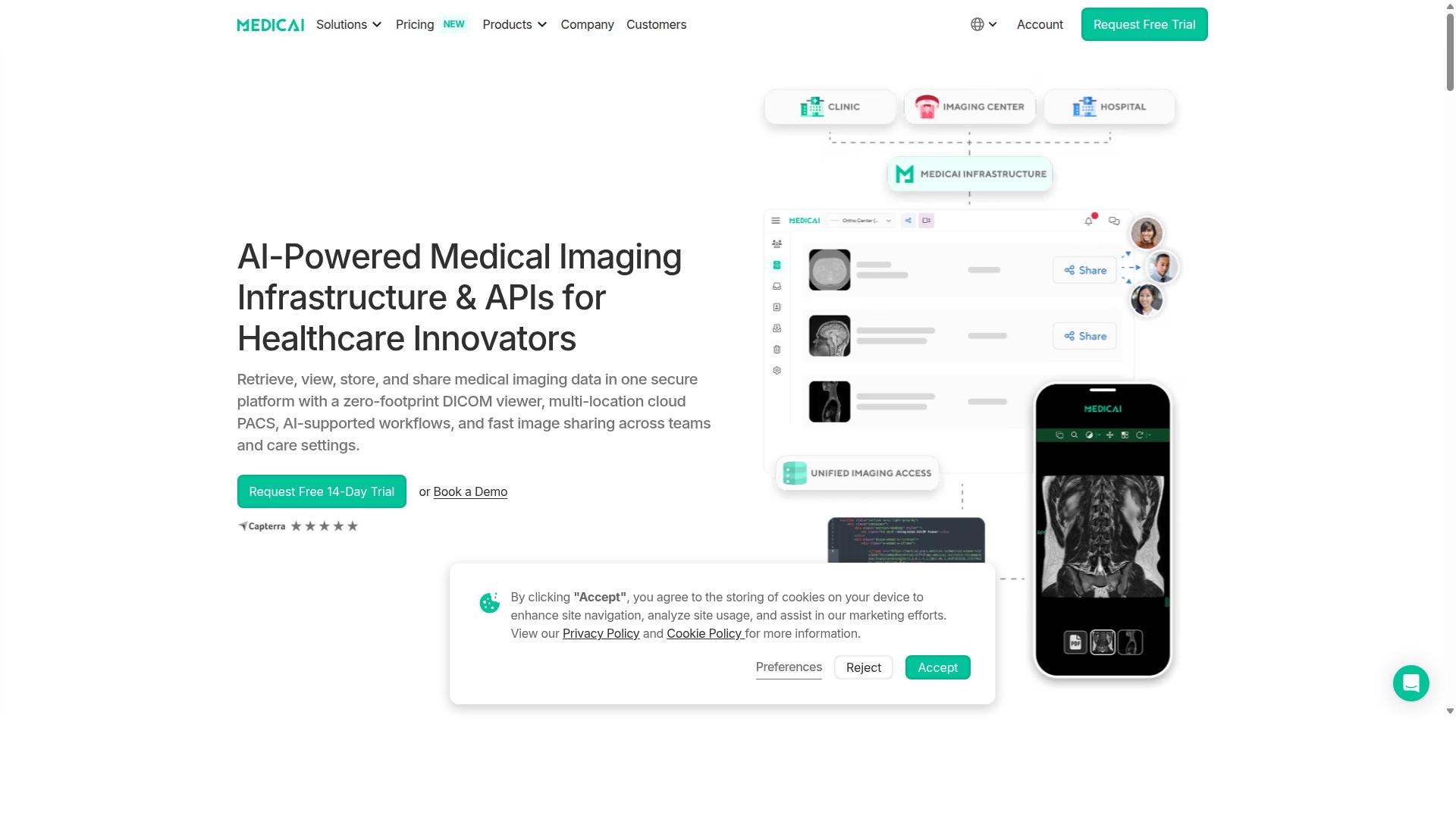
Medicai is a cloud-based medical imaging platform that lets healthcare providers retrieve, view, store, and share studies in a single secure space.
The platform delivers its capabilities through three core components. A zero-footprint DICOM viewer runs directly in any web browser without requiring local software installation.
Cloud storage operates as a multi-location cloud PACS system, keeping imaging data accessible and organized across different care settings.
Secure sharing enables fast image transfer between teams while maintaining HIPAA compliance and data encryption standards.
These three components work together to create the Imaging Infrastructure as a Service model that Medicai provides. Healthcare organizations use this infrastructure to support high-performance diagnostic speed across radiology workflows.
Why Medicai Delivers High-Performance Diagnostic Speed
The platform shortens the interval between image acquisition and diagnosis by removing local hardware bottlenecks. This approach enables radiologists to move from scan completion to reading without waiting on workstation downloads or file transfers.
Modern diagnostic speed is measured in seconds rather than minutes. The system uses GPU-powered cloud rendering to process CT and MRI volumes quickly. This allows 3D reconstructions that appear on screen without local processing delays.
Edge caching nodes position rendering resources closer to clinical sites. This reduces transmission time across networks and improves consistency for remote reading sessions. The result is smoother workflow when multiple locations access the same study simultaneously.
Lossless compression maintains diagnostic quality while reducing file sizes. This technique lowers the data volume that travels between scanner and viewer. Radiologists see full detail without extended loading times.
These three tactics work together to support real-time diagnostics across different care settings. High-performance imaging becomes possible even when sites have limited local infrastructure. The approach prioritizes both speed and image fidelity for clinical decision making.
Key Features and What Makes Medicai Stand Out
Three tightly integrated capabilities differentiate Medicai from traditional imaging stacks.
The platform combines a browser-based viewer, AI-supported tools, and multi-site cloud storage. These elements work together to reduce delays in image loading and interpretation.
Each component addresses a distinct part of the diagnostic process. The result is faster access to studies and quicker clinical decisions across departments and locations.
Zero-Footprint DICOM Viewer
The viewer launches instantly in any browser without plug-ins or local installs.
HTML5 rendering handles CT, MRI, ultrasound, and PET studies directly in the browser. No additional software is required for loading or viewing these modalities.
Annotation tools save directly to the study record. Changes remain with the original images and stay available to all authorized users.
HIPAA-grade AES-256 encryption protects every pixel sent over the wire. Data stays secure during transmission and storage.
AI-Supported Workflows
Embedded AI models accelerate routine measurements and flag urgent findings.
AI-generated measurement suggestions appear within the viewer. These suggestions reduce the number of clicks needed to complete common tasks.
Automated lesion segmentation masks display as editable overlays. Radiologists can adjust the outlines before finalizing reports.
Real-time triage scores reorder worklists by urgency. Studies with higher priority move to the top of the queue automatically.
Cloud PACS and Multi-Location Access
A unified cloud archive replaces multiple on-prem PACS while enabling instant access from any connected site.
One dashboard accepts uploads from any modality. Studies from different manufacturers appear in the same interface without manual reformatting.
Automatic synchronization keeps data current across connected locations. Each site sees the latest version of every study.
Automated backup maintains recovery points. Recovery points stay current even during network interruptions.
Pricing and Plans
Medicai offers tiered monthly subscriptions that scale storage and connectivity. The platform provides two main plans, each designed to support high-performance diagnostic speed for different practice sizes and imaging demands.
The Starter plan is priced at $249 per month. It includes 500 GB of cloud storage and allows unlimited user accounts. This option supports zero connected locations, making it ideal for practices that rely on cloud access without on-premise hardware.
The Standard plan costs $749 per month. It expands storage to 2 TB and maintains unlimited user accounts. This tier adds one connected location, which benefits clinics that need PACS integration alongside cloud rendering.
| Feature | Starter | Standard |
|---|---|---|
| Monthly Price | $249 | $749 |
| Storage | 500 GB | 2 TB |
| User Accounts | Unlimited | Unlimited |
| Connected Locations | 0 | 1 |
Overage usage is billed at $0.10 per additional gigabyte. Both plans support a free 14-day trial of Starter features with no credit card required. Yearly billing reduces costs by 15 percent, bringing Starter to $209 per month and Standard to $639 per month.
A $1,000 one-time DICOM Gateway setup fee applies per connected location. Enterprise customers receive custom storage and multiple locations. Per-study pricing is also available for larger organizations that prefer usage-based billing.
Trust Signals
Independent audits and regulatory clearances demonstrate consistent data protection. Medicai follows HIPAA and GDPR compliance standards across all operations. These requirements protect patient information during every step of the diagnostic process.
The company maintains FDA 510(k) clearance for its diagnostic viewer. This regulatory approval confirms that the viewer meets established safety and effectiveness standards for medical imaging. Healthcare providers can rely on the cleared technology for clinical decision making.
CE mark certification adds another layer of verification for medical device compliance. This European standard ensures the platform meets health and safety requirements. Organizations operating across multiple regions benefit from this unified regulatory approach.
Medicai processed 50M+ yearly API transactions without security incidents. This track record shows the platform handles high volumes of medical data while maintaining protection standards. The scale of transactions demonstrates proven reliability in production environments.
Who Should Use Medicai
Hospitals and outpatient centers that need rapid image exchange across departments or networks will benefit most. Medicai serves healthcare providers including hospitals and imaging centers that require immediate access to studies from multiple sources. The platform connects these facilities through cloud-based infrastructure that supports real-time collaboration.
Specialty care providers rely on Medicai when diagnostic speed determines patient outcomes. Orthopedics teams use the system to review fracture patterns and joint replacements without delays. Neurology departments access brain and spine imaging for urgent stroke protocols and surgical planning.
Oncology practices depend on Medicai for tumor board coordination where multiple specialists review cases simultaneously. Radiology groups process high volumes of CT and MRI studies through the zero-footprint viewer. Cardiology teams examine cardiac imaging for procedural guidance and follow-up assessments.
Ophthalmology clinics benefit from high-resolution retinal and OCT image sharing during consultations. OB-GYN practices exchange prenatal ultrasound studies across maternal-fetal medicine networks. Pulmonology departments review chest CT scans for interstitial lung disease monitoring.
Dentistry practices utilize Medicai for cone beam CT analysis and treatment planning. Gastroenterologists access endoscopic and imaging studies for collaborative case review. Virtual care providers integrate the platform for telemedicine consultations requiring diagnostic imaging.
Teleradiology services connect remote radiologists to hospital PACS systems through Medicai infrastructure. Personal injury lawyers coordinate medical imaging evidence for legal proceedings. Clinical trials organizations manage standardized imaging protocols across multiple research sites.
Medical education organizations leverage Medicai for teaching file management and case study distribution. Patients access their imaging through the Patient Portal for second opinions and care coordination. This broad user base demonstrates Medicai effectiveness across diverse healthcare environments requiring high-performance diagnostic speed.
Final Verdict
Medicai replaces fragmented imaging workflows with a single HIPAA-compliant cloud platform that supports AI tools and multi-site access.
Performance stands out as the first major value driver. High-performance imaging runs efficiently because the platform uses GPU acceleration, lossless compression, and cloud rendering to achieve low latency. Radiologists can review CT scan analysis, MRI processing, and ultrasound streaming without local hardware delays.
Compliance forms the second value driver. Data encryption protects patient information at every stage. HIPAA compliance ensures legal standards are met across all locations, and secure access remains available for multi-modality support without compromising security protocols.
Cost predictability completes the value picture. Organizations avoid surprise hardware expenses because the platform functions through cloud infrastructure. Teams can scale usage without purchasing new servers or specialized workstations for 3D reconstruction tasks.
Medicai USA operates from 7901 4th St N, STE 300, St. Petersburg, FL, 33702 and can be reached at +1 (832) 220 1035. Medicai Romania is located at 53-55 N Filipescu, 5th Floor, Sector 2, Bucharest, 020961 and can be contacted at +40 316 305 875.
Recommended Resources: