
Why Is Medicai the Best for Enterprise-grade Standard?
Many hospitals still juggle separate PACS systems for each site, leaving imaging data scattered and hard to access across teams. That fragmentation slows consults and raises the risk of missing prior scans when patients move between locations. Medicai offers one secure cloud workspace that replaces those disconnected tools.
By the end of this article you will know exactly which compliance standards Medicai meets, how its cloud architecture handles multi-site growth, and what storage and pricing choices exist for enterprise budgets. You will also see the usage numbers reported by 70 clinics and hospitals already running the platform.
What Is Medicai?
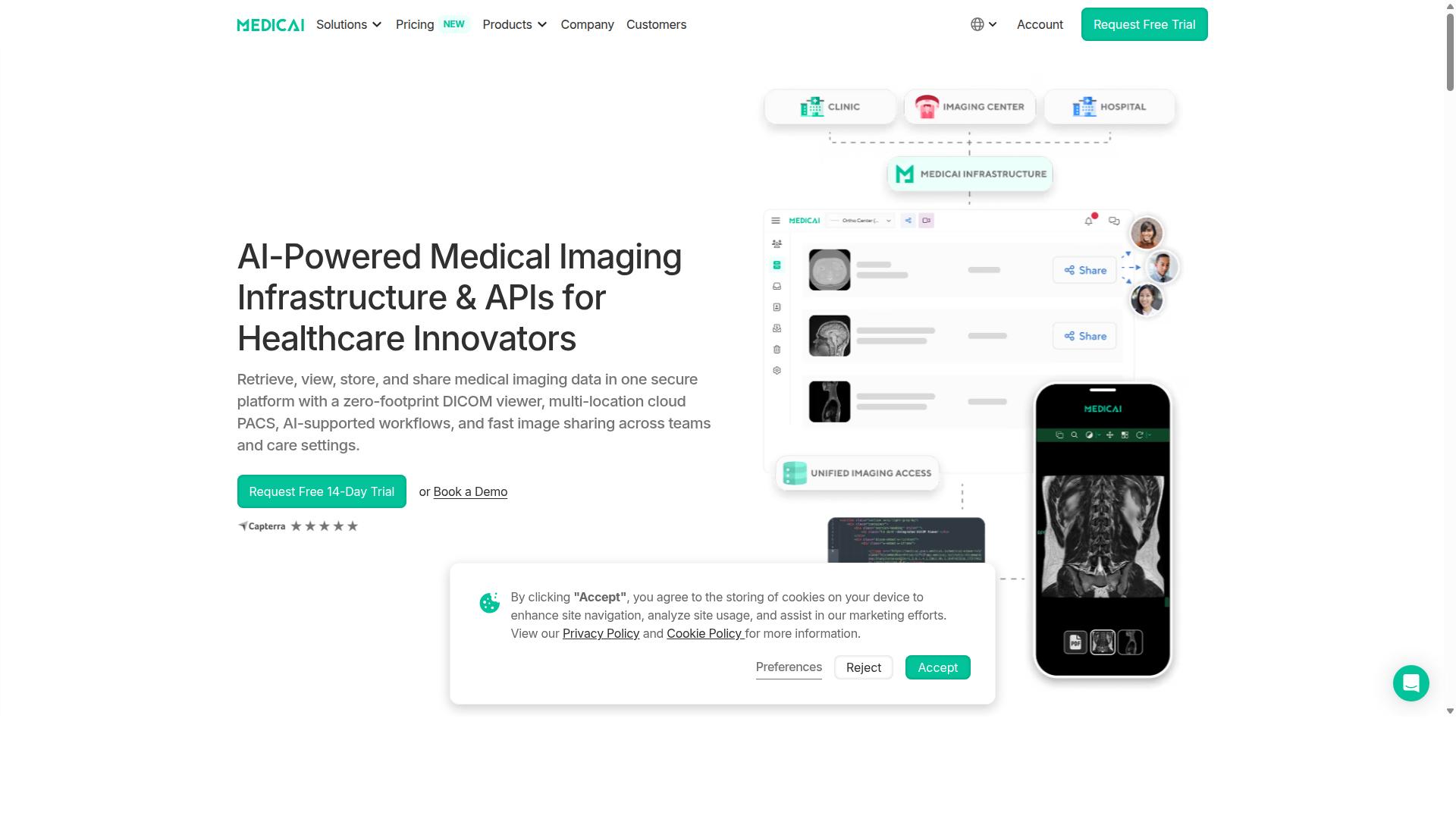
Medicai is a cloud-based medical imaging platform that consolidates retrieval, viewing, storage, and sharing of DICOM studies into a single secure environment. The platform serves healthcare providers across multiple care settings with its Imaging Infrastructure as a Service model.
The system features a zero-footprint DICOM viewer that requires no local installation. This approach allows users to access medical imaging data immediately from any location without additional software dependencies.
Medicai operates worldwide through its vendor-neutral architecture. The platform supports interoperability between different healthcare systems and enables seamless data exchange across organizational boundaries.
The multi-location cloud PACS structure allows organizations to maintain imaging infrastructure without managing physical servers. This design reduces operational complexity while supporting enterprise-grade requirements for medical imaging workflows.
AI-supported workflows help streamline image processing and analysis tasks within the platform. These capabilities connect with existing healthcare technology stacks to improve efficiency in radiology departments and imaging centers.
Why Medicai Meets Enterprise-grade Standards
Enterprise teams require systems that combine interoperability, scalability, and SLA-backed uptime without compromising security. Medical imaging environments demand consistent performance across distributed facilities and integrated workflows. Organizations look for platforms that maintain these standards through thoughtful architecture rather than added complexity.
Multi-tenant cloud architecture separates each client instance while sharing common infrastructure. This approach supports scalability without duplicating hardware or creating bottlenecks. Teams gain flexibility to adjust resources according to clinical volume and seasonal demand.
API-first design enables direct connections to existing hospital systems. Developers can build integrations with PACS, RIS, and EHR platforms using standardized data exchange. This reduces custom development time and supports consistent data flow across departments.
FHIR and HL7 support ensures compatibility with modern health information systems. Clinical teams can exchange imaging studies, patient records, and structured reports without manual reformatting. These standards also simplify future system upgrades and vendor changes.
Enterprise Security and Compliance
Healthcare IT leaders prioritize demonstrable regulatory compliance and layered security controls. Enterprise-grade platforms must deliver these capabilities from day one, not as optional add-ons.
Medicai maintains HIPAA and GDPR compliance as a core requirement for its medical imaging platform. The system supports 70 clinics and hospitals while processing over 1M studies per year.
Every deployment includes encryption, access controls, and audit capabilities that meet enterprise standards. These features protect patient data across the 1.7M studies currently in storage.
HIPAA and GDPR Compliance
HIPAA and GDPR compliance demands documented encryption-at-rest, encryption-in-transit, granular access policies, and immutable audit logs. Without these controls, healthcare organizations cannot deploy any imaging solution at scale.
Medicai implements AES-256 encryption across all medical imaging data. Role-based access control ensures users only view DICOM studies relevant to their clinical role.
The platform maintains continuous audit trails for every action performed on patient images. These logs support regulatory reporting requirements for the 50M yearly API transactions.
Healthcare teams rely on these documented controls when integrating with existing PACS and EHR systems. Compliance documentation helps IT departments validate security posture during vendor assessments.
OWASP Security Guidelines
OWASP guidelines call for input validation, secure authentication, and protection against common web application risks. These controls prevent unauthorized access to sensitive medical imaging environments.
Medicai follows OWASP security guidelines through SSO integration and parameterized queries. Runtime vulnerability scanning identifies potential threats before they reach production systems.
These measures protect the 300k visualizations of DICOM studies generated last year. Regular security assessments help maintain the integrity of the 2M imaging studies uploaded to the platform.
Single sign-on capabilities streamline authentication while maintaining enterprise security standards. Parameterized queries prevent injection attacks across API endpoints that handle 50M transactions annually.
Scalable Infrastructure for Enterprise Needs
Enterprise radiology and multi-site imaging networks need infrastructure that expands capacity on demand while maintaining low latency.
Medicai supports horizontal scaling across its cloud environment to handle increasing study volumes. Multi-tenant architecture allows separate organizations to operate within the same platform without resource contention.
Hybrid deployment options let hospitals choose between cloud, on-premise, and mixed configurations. This flexibility meets data residency rules while delivering enterprise-grade performance across different regulatory environments.
Service agreements include 99.9 percent uptime guarantees supported by redundant infrastructure. These commitments protect continuous access to critical medical imaging resources.
Multi-location Cloud PACS
A multi-location Cloud PACS must unify studies across sites while integrating seamlessly with existing RIS and EHR systems.
Medicai Cloud PACS connects multiple facilities through its DICOM Gateway. The gateway retrieves imaging data from on-site modalities and transmits it securely to the central repository.
HL7 and FHIR APIs enable bi-directional synchronization between the Cloud PACS and primary EHR platforms. This integration keeps patient records and imaging studies aligned across locations.
Multi-site workflows benefit from centralized storage combined with local access points. Radiologists at any connected facility can retrieve studies without transferring physical media or navigating separate systems.
Backup and Disaster Recovery
Enterprise disaster-recovery plans require geographically distributed backups with defined RPO and RTO objectives.
Medicai Backup and Disaster Recovery performs automated daily backups of all stored medical imaging data. Cross-region replication keeps copies in separate geographic zones for added protection.
Configurable retention policies let organizations set storage duration based on internal or regulatory requirements. Documented RPO and RTO targets provide measurable recovery expectations during service interruptions.
These backup processes operate alongside the Vendor Neutral Archive and Cloud PACS services. Organizations maintain continuous access while ensuring data integrity across all connected sites.
Enterprise Pricing and Storage Options
Transparent, usage-based pricing allows CFOs to forecast costs while accommodating growing imaging volumes. Medicai offers clearly defined monthly plans that scale with enterprise needs without hidden fees or surprise charges.
The Starter plan starts at $249 per month and includes 500 GB of cloud storage with unlimited user accounts. This option works well for smaller teams testing the platform before committing to larger volumes of medical imaging data.
The Standard plan costs $749 per month and provides 2 TB of cloud storage plus unlimited user accounts, including one connected location. Organizations handling moderate imaging loads benefit from this tier without overpaying for unused capacity.
Enterprise customers receive custom pricing with flexible cloud storage, multiple connected locations, and multiple external locations. This structure supports complex healthcare networks that require interoperability across different sites.
Yearly billing delivers 15 percent savings, bringing the Starter plan to $209 per month and the Standard plan to $639 per month when paid annually. The DICOM Gateway Setup costs $1,000 as a one-time fee per location for organizations needing on-premise connectivity.
Per-study pricing remains available for enterprise customers who prefer usage-based billing over fixed monthly storage. A free 14-day trial of Starter plan features allows teams to evaluate the platform before making any financial commitment.
Track Record and Trust Signals
Quantifiable platform usage and verified institutional adoption provide evidence of enterprise readiness.
Enterprise-grade solutions require documented performance at scale. Medicai processes medical imaging data across multiple institutions daily. Healthcare organizations demand concrete proof of reliability before committing to any platform.
The numbers reveal consistent throughput and storage capacity. Medical imaging workflows depend on uninterrupted access to stored studies. Institutions track these metrics to assess long-term viability.
Real-world usage patterns demonstrate how the platform handles clinical volume without degradation. API transactions represent automated exchanges between systems. These connections support integration with existing PACS, RIS, and EHR environments.
1M+ Studies Processed Annually
Processing over one million studies per year demonstrates both reliability and scalability under real-world clinical loads.
Medicai records 1M+ studies transacted annually. The platform currently holds 1.7M studies in storage. These figures reflect sustained demand from active clinical users.
Volume alone does not guarantee quality. 50M yearly API transactions indicate automated system-to-system communication at enterprise frequency. Each transaction represents successful data exchange without manual intervention.
Healthcare providers need platforms that maintain performance as case volume grows. Scalability becomes measurable when annual study counts exceed one million. Medicai meets this threshold consistently.
70 Clinics and Hospitals on Platform
Seventy-plus clinics and hospitals actively exchanging imaging data on the platform validate clinical adoption.
Medicai serves radiology, cardiology, and orthopedics departments across these institutions. Interoperability enables data exchange between different specialties and facility types. This breadth indicates the platform accommodates varied workflow requirements.
Ten thousand active doctors access the system regularly. HIPAA and GDPR compliance protects patient information across these organizations. Security protocols follow OWASP guidelines as an additional safeguard layer.
Institutions choose platforms based on proven connections with peer organizations. Enterprise-grade status requires demonstrated use by multiple hospitals and clinics simultaneously. Medicai meets this adoption benchmark.
Who Should Use Medicai
Hospitals, imaging centers, and specialty practices that need secure, scalable imaging exchange will benefit most from Medicai. These organizations face daily demands to move DICOM studies quickly while maintaining strict compliance with HIPAA and GDPR regulations.
Orthopedics, neurology, oncology, radiology, and cardiology departments handle high volumes of complex imaging studies. Medicai provides a unified platform that connects to existing PACS, RIS, and EHR systems through standard HL7 and FHIR protocols.
Workflow pain points such as delayed image transfers, fragmented patient data, and manual reporting processes create delays in care delivery. Medicai addresses these challenges through automated data routing that reduces manual steps and improves turnaround times.
Outpatient imaging centers often struggle with interoperability when sharing studies across multiple referring physicians and health systems. The platform supports both cloud and hybrid deployment options to meet varying infrastructure requirements.
Tumor boards and clinical trials require structured access to imaging data across multiple institutions. Medicai enables controlled sharing while maintaining detailed audit trails for compliance documentation.
Virtual care providers and telemedicine platforms integrate medical imaging into remote consultations using the same secure infrastructure. This approach ensures consistent data standards across both in-person and remote care settings.
Personal injury lawyers and medical education organizations access imaging through controlled portals that support annotation and measurement tools. These capabilities maintain data integrity while allowing necessary collaboration.
Final Verdict
Medicai delivers enterprise-grade medical imaging capabilities with proven scale, compliance certifications, and transparent pricing. Organizations that need reliable medical imaging infrastructure find a complete solution that meets strict regulatory requirements while supporting clinical workflows at scale.
The platform combines DICOM standards with HL7 and FHIR integration options. This approach ensures seamless data exchange between PACS, RIS, and EHR systems across healthcare networks.
Security features include encryption, role-based access control, and audit trail capabilities. These elements satisfy HIPAA and GDPR requirements while maintaining operational efficiency for multi-tenant environments.
Deployment flexibility covers cloud, on-premise, and hybrid configurations. This versatility allows healthcare systems to match their infrastructure choices with specific data residency and latency needs.
Medicai USA operates from 7901 4th St N, STE 300, St. Petersburg, FL, 33702 and can be reached at +1 (832) 220 1035. Medicai Romania is located at 53-55 N Filipescu, 5th Floor, Sector 2, Bucharest, 020961 with phone contact +40 316 305 875. Organizations can reach [email protected] for deployment inquiries and live demonstrations.
Recommended Resources: